
Picture a lawn suit seller in Lahore who asks ChatGPT for "20 blog posts about summer fashion," pastes them onto her website in one evening, and waits for orders. Three months later, Google sends her almost nothing. The posts read like everyone else's, they answer questions nobody in Pakistan is asking, and two of them quote prices in dollars.
That story is made up, but versions of it play out every week. AI tools really can make SEO faster and cheaper for a small Pakistani business. They can also waste months if you use them as a content vending machine. This guide covers what has changed in search here, what Google actually allows, and seven practical ways to use AI tools for SEO in Pakistan without hurting your rankings.
Why AI and SEO matter more in Pakistan this year
Start with the audience. DataReportal's Digital 2026: Pakistan report counts 117 million internet users in the country as of October 2025, about 45.6% of the population. The median age is 20.6. These are young customers, and most of them reach the internet through a phone.
The phone part is not a guess. Ministry of IT data for July 2026 shows 166.12 million broadband subscriptions, of which 161.71 million are mobile broadband and only 4.41 million are fixed connections. If your website is slow or awkward on a mid-range Android phone, most of your potential visitors will feel it.
And they search on Google. StatCounter puts Google's share of search in Pakistan at 94.88% for October 2026. For a Pakistani business, "SEO" in practice means Google SEO.
What has changed is how Google answers. In May 2025 Google expanded AI Overviews to more than 200 countries and over 40 languages, adding Urdu. AI Mode reached Pakistan in English in August 2025, and in October 2025 Google rolled it out in more than 35 new languages, with Urdu among them according to PhoneWorld's coverage. Google says people ask AI Mode questions nearly three times longer than traditional searches.
So your customer in Faisalabad may now type, or speak, something like "best solar inverter for a 5 marla house with load shedding, under 2 lakh" and get a written answer with a few cited links. The businesses that get cited are the ones whose pages actually answer that kind of question.
Money is moving online too. The State Bank's payment systems review for FY26 says digital channels handled 92% of retail payment transactions, and branchless banking app users (the JazzCash and Easypaisa type of wallet) reached 99.1 million. The gap between "found you on Google" and "paid you" keeps getting shorter.
What Google actually says about AI-written content
A lot of bad advice floats around Pakistani Facebook groups on this, so here is the source.
Google does not ban AI-assisted content. Its guidance on generative AI content says AI can be useful for research and for adding structure to original content. The same page warns that AI models "don't retrieve facts" and can produce inaccuracies, so you should fact-check everything before publishing, including page titles, meta descriptions and image alt text.
What Google does penalise is scaled content abuse: generating many pages mainly to manipulate rankings without adding value for users. The policy applies "no matter how it's created," whether by AI, by a team of cheap writers, or both.
Google's guide to its generative AI search features adds a useful idea. It separates "commodity content," the generic "7 tips" article anyone could write, from "non-commodity content" based on real experience. A Karachi caterer explaining how they price a 300-guest mehndi menu is non-commodity. A generic "how to choose a caterer" post is not.
That distinction is the whole game. Use AI to do the slow parts of SEO faster, and keep the experience, the local knowledge and the final judgement human.
7 practical ways to use AI tools for SEO in Pakistan
1. Keyword research in English, Urdu and Roman Urdu
Pakistani searchers mix languages constantly. The same person might search "bridal makeup price Lahore," "dulhan makeup kitni ki hoti hai," and the same phrase in Urdu script on another day. Most English-first keyword tools handle the Roman Urdu part poorly, which is where AI chat tools help.
A prompt that works well:
"I run a home bakery in Rawalpindi that takes custom cake orders on WhatsApp. List 40 ways customers in Pakistan might search for this on Google, mixing English, Roman Urdu and Urdu script. Group them by intent: price, near me, occasion, and delivery."
You will get phrases you had not thought of, such as "birthday cake home delivery Bahria Town" or "fondant cake rate per pound." But be clear about the limit: AI tools do not know search volumes. They guess. Take the list into Google Keyword Planner (free with a Google Ads account), Google Trends, and your own Search Console data to see which phrases people actually use. Expect Roman Urdu spellings to vary ("kitne," "kitnay," "kitni"), and write naturally rather than stuffing every variation into one page.

2. Turn your WhatsApp questions into pages that rank
Many Pakistani businesses run on WhatsApp. That inbox is the best keyword research you own, because it holds the exact questions real customers ask before buying: "COD available hai?", "Easypaisa pe payment ho sakti hai?", "Islamabad delivery kitne din mein?", "size chart bhej dein."
Copy a few weeks of common questions into a document, after removing names, phone numbers and addresses, and ask an AI tool to cluster them into themes. Each strong theme becomes a section on a product page, a delivery and payment page, or a proper FAQ. These pages tend to do well because they answer specific questions that generic competitor pages skip, which is also the kind of content AI Overviews like to cite.
3. Use AI for briefs and outlines, then write from experience
Ask the AI for a content brief, not a finished article: the questions a reader will have, a logical heading structure, related terms, and the points competitors usually cover. Then write the article yourself, or have your writer do it, adding what only you know.
For a real estate agent in DHA Lahore, that might mean actual rent ranges from listings you handled this year, the paperwork tenants always forget, or why one phase floods in monsoon. AI cannot supply that. Readers and Google both notice when it is missing.
A good test before publishing: delete your business name from the article. If it could belong to any agency in any country, it needs more of you in it.
4. Product descriptions for your store and your Daraz listings
If you sell 200 products, writing unique descriptions by hand is painful. AI can draft them quickly from your own notes on fabric, sizing, warranty and use. Feed it real details ("2-piece khaddar, unstitched, 2.5 metre shirt, dupatta not included") and ask for a short, plain description plus a bullet list.
Two cautions. First, do not paste the manufacturer's text and ask for a "rewrite" across your whole catalogue; that is close to what the scaled content policy describes. Second, if you advertise through Google Merchant Center, Google requires AI-generated product images to carry specific metadata, and AI-generated titles and descriptions to be labelled. Check those rules before you automate anything for Shopping ads.
The same drafted descriptions can be adapted for Daraz, Instagram captions and WhatsApp catalogue entries, so one round of work serves several channels.
5. Local SEO and your Google Business Profile
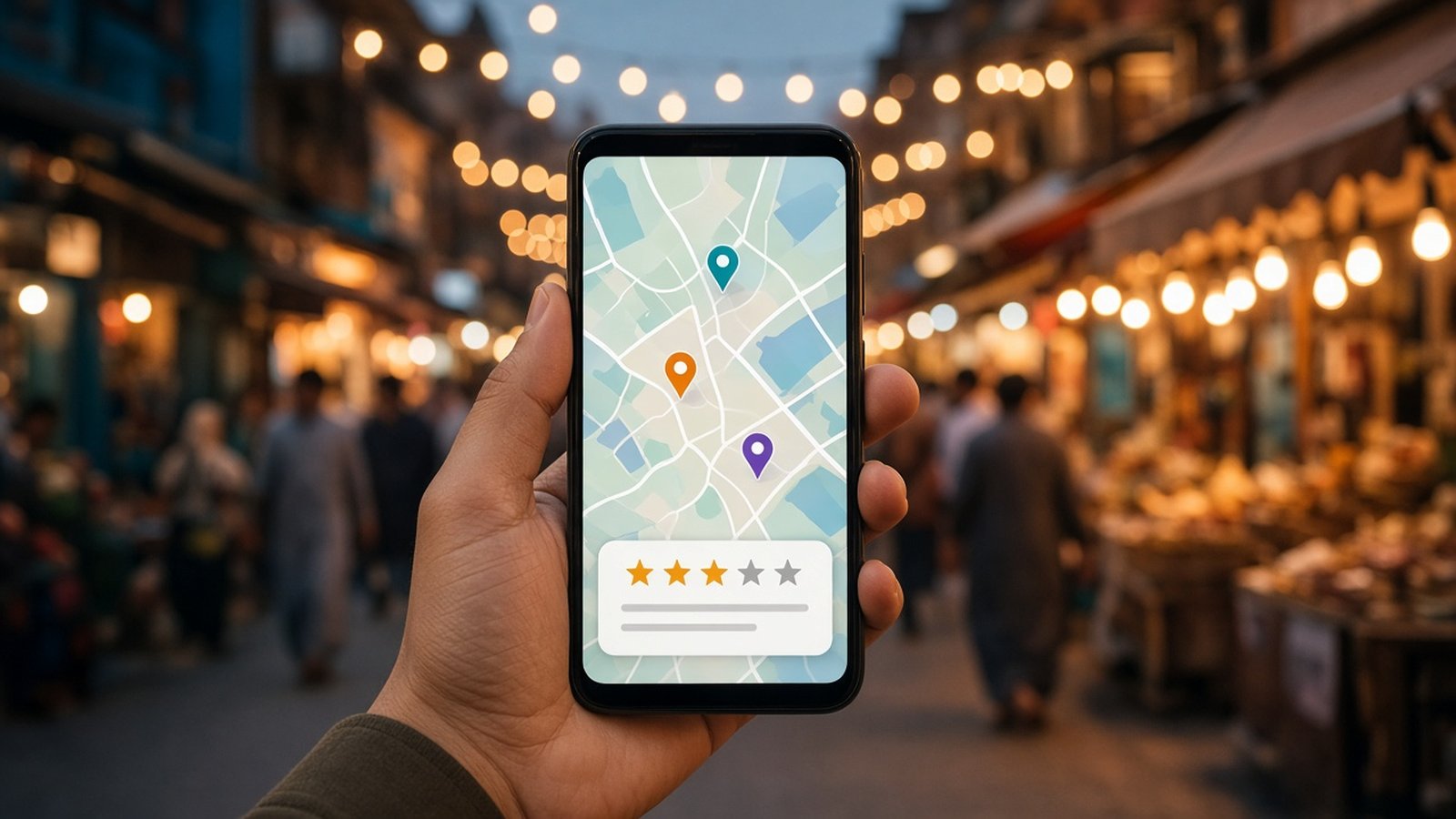
For clinics, salons, restaurants, schools, repair shops and showrooms, the Google Business Profile often brings more customers than the website. Google's own local ranking help page says local results depend mainly on relevance, distance and prominence, and that more reviews and positive ratings can help your local ranking. It also says plainly that there is no way to pay for a better local ranking.
AI helps with the routine work here:
- Drafting replies to reviews in the language the customer used, whether English, Urdu or Roman Urdu. Edit each one so it mentions the actual visit; copy-paste replies look lazy.
- Writing a clear business description and service list that uses the words customers search for.
- Planning a month of Google posts around real events: Ramadan timings, Eid offers, 11.11 sales, wedding season, school admissions.
Never use AI to write fake reviews. It breaks Google's policies on fake engagement, and profiles caught doing it can have reviews removed or face restrictions.
6. Technical SEO help without hiring a developer for every small fix
This is where AI chat tools quietly save the most time. You can paste in a Search Console error and ask what it means in plain language. You can ask for a first draft of LocalBusiness or Product schema markup, a redirect rule, or a robots.txt file, then test the result with Google's Rich Results Test before going live.
Speed deserves special attention. Ookla data in the DataReportal report puts Pakistan's median mobile download speed at 24.32 Mbps at the end of 2025, and many users are on much slower connections in practice. Ask an AI tool to review your page list and spot heavy images, too many plugins or render-blocking scripts. Then confirm with PageSpeed Insights, which measures the real thing.
The caution: AI can produce confident code that is wrong. Make a backup before changing anything on a live site, and test on a staging copy if you can.
7. Measure whether you appear in AI answers
For a long time nobody could see how often their site showed up inside AI Overviews. That changed this year. Google introduced generative AI performance reports in Search Console, and as of August 31, 2026 they are available to all websites worldwide. They show impressions in AI Overviews and AI Mode by page, country, device and date.
One honest caveat: these reports show impressions, not clicks from AI answers, so treat them as a visibility signal. Pair them with the normal Performance report and with what you can measure directly: enquiries, WhatsApp clicks and sales.
A realistic AI SEO toolkit on a rupee budget
You do not need expensive software to start. A sensible stack for a small Pakistani business looks like this:
- Google Search Console (free): the single most important SEO tool, now with AI visibility data.
- Google Business Profile (free): essential for any business with a physical location or service area.
- Google Keyword Planner and Google Trends (free): to check whether AI-suggested keywords are real.
- A general AI assistant such as ChatGPT or Gemini: the free tiers are enough for briefs, keyword ideas, review replies and explaining errors.
- PageSpeed Insights (free): to test mobile speed.
Paid SEO suites can be worth it once you are publishing regularly or managing several sites. Most bill in US dollars, so check what your bank charges on international card payments before signing up, since the final PKR amount can be higher than the listed price.
Common mistakes to avoid
- Publishing AI statistics without checking them. AI tools invent numbers and sources that sound real. Every figure on your site should link to where it came from.
- Creating a page for every city. "Best plumber in Lahore," "Best plumber in Multan," and 40 more with only the city name changed is exactly the kind of thin, scaled content Google's policies describe. Build city pages only where you genuinely serve customers and have something specific to say.
- Machine-translating everything into Urdu. Urdu content can be a real advantage because there is less competition, but a stiff, literal translation reads badly. Have a fluent person edit it.
- Pasting private customer data into AI tools. Strip out names, numbers, CNIC details and addresses first.
- Expecting overnight results. SEO still takes months. AI makes the work faster; it does not make Google faster.
If you hire help, ask how they use AI. Pakistan has a large freelance and agency talent pool (freelancers earned a record $1.76 billion in export income in FY2025-26), and quality varies widely. A good SEO partner should be able to show you which parts are AI-assisted and who checks them.
A simple 30-day plan to get started
- Week 1: Set up or clean up Search Console and your Google Business Profile. Fix wrong hours, categories and phone numbers.
- Week 2: Collect your most common WhatsApp and DM questions. Use AI to group them, then build or improve one FAQ or delivery-and-payment page.
- Week 3: Run a mixed-language keyword session with AI, check the results in Keyword Planner, and rewrite titles and descriptions for your five most important pages.
- Week 4: Test mobile speed, compress heavy images, and start replying to every Google review. Note your baseline numbers so you can compare in 90 days.
Frequently asked questions
Will Google penalise my website for using AI content?
Not for using AI by itself. Google's guidance says AI-generated content is fine if it is helpful, accurate and made for people. Problems start when you publish large amounts of low-value content mainly to rank, which falls under the scaled content abuse policy.
Are AI Overviews available in Urdu in Pakistan?
Yes. Google added Urdu when it expanded AI Overviews in May 2025, and AI Mode, which first launched in Pakistan in English in August 2025, gained Urdu support in October 2025.
Should I write my website content in Urdu, Roman Urdu or English?
It depends on your customers. Many Pakistani businesses do best with English pages that include natural Roman Urdu phrases customers actually use, plus Urdu content where their audience reads Urdu. Check Search Console to see which queries already bring visitors.
What is the best free AI tool for SEO in Pakistan?
There is no single best one. A free AI assistant such as ChatGPT or Gemini works well for ideas and drafts, but the most valuable free SEO tool is still Google Search Console, because it shows real data from your own site.
Can AI do my SEO completely?
No. AI can speed up research, drafting and technical fixes, but it cannot know your customers, check its own facts reliably, or build the reputation that earns links and reviews. Treat it as a fast assistant, not a replacement for strategy.
The bottom line
AI tools have made good SEO cheaper and quicker for Pakistani businesses, especially small ones that could never afford a full marketing team. The winners will not be the businesses that publish the most AI text. They will be the ones that use AI to understand their customers' real questions, in English, Urdu and Roman Urdu, and answer them better than anyone else.
If you want a second opinion on where your website stands, LinkTrust Digital offers a free review. We look at your site, your Google Business Profile and your competitors, and tell you plainly what is holding you back, in English or Urdu. Get in touch here and we will reply within one working day.